Carbohydrate core
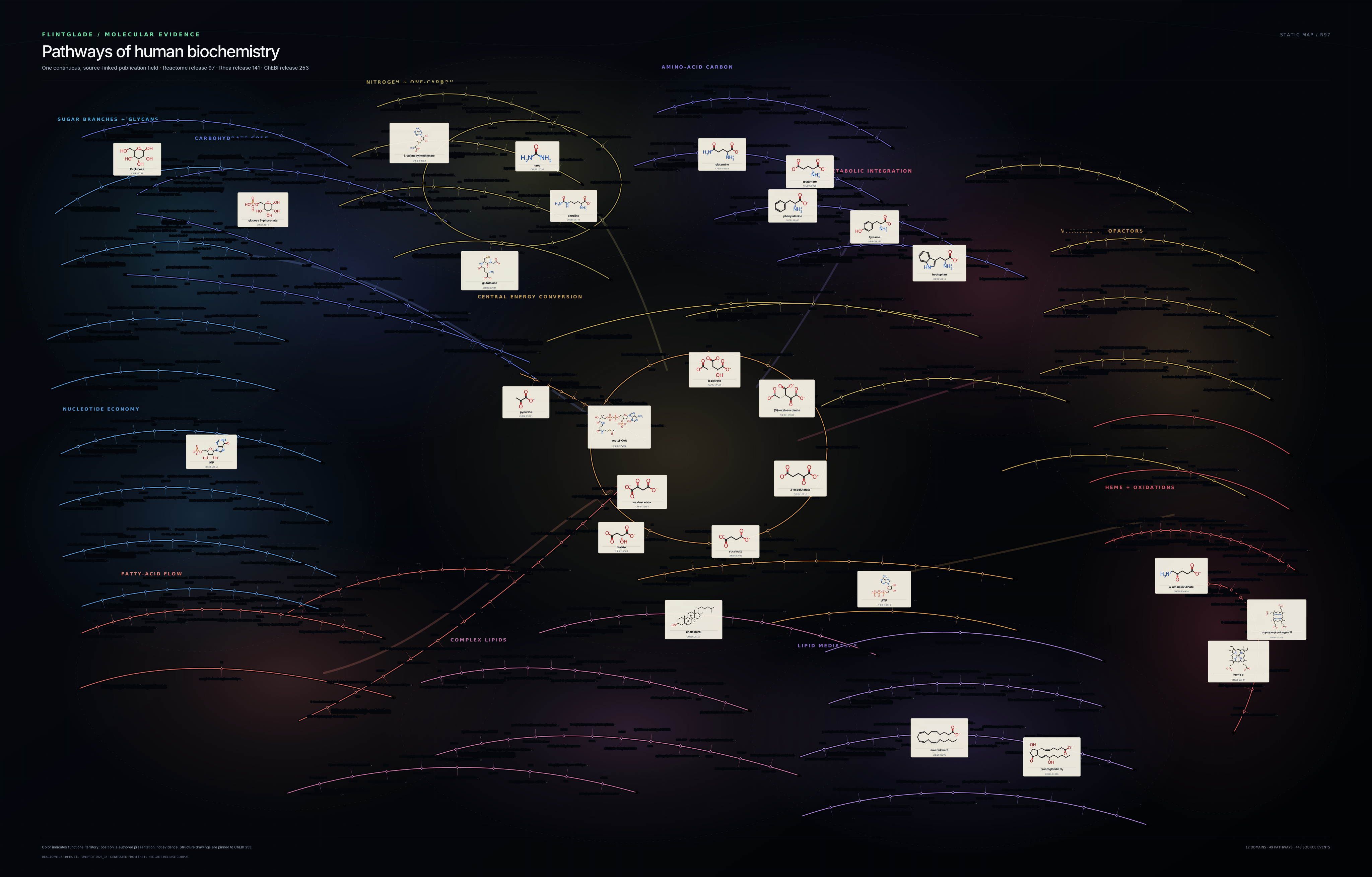
Routes that capture, store, release and repartition six-carbon sugars, with glycolysis as a central exchange rather than an isolated tube.
Loading the map…
The map as a reading list: 2,039 reactions across 58 pathways. Every territory, pathway and reaction has a page with its equation, inputs and outputs, catalysts and Reactome sources.
Routes that capture, store, release and repartition six-carbon sugars, with glycolysis as a central exchange rather than an isolated tube.
Monosaccharide entry routes and the activated-sugar chemistry used to construct, remodel and recover extracellular-matrix carbohydrates.
The mitochondrial and cytosolic interfaces that oxidize carbon, transfer reducing equivalents and couple electron movement to ATP formation.
Shuttles, exchange reactions and alternate fuels that connect otherwise separated compartments and pathway neighborhoods.
Activation, mitochondrial entry, synthesis and staged oxidation of fatty-acid carbon.
Membrane, storage and signaling-lipid chemistry spanning the endoplasmic reticulum, Golgi, mitochondria, lysosome and plasma membrane.
Sterol-derived hormones, bile acids and oxygenated polyunsaturated-fatty-acid mediators.
Amino-acid-specific transformations that connect carbon skeletons to central metabolism while preserving nitrogen handling as a separate question.
Nitrogen disposal, one-carbon transfer, sulfur chemistry and redox-buffer synthesis at the amino-acid–nucleotide interface.
Construction, interconversion, salvage and breakdown of purine and pyrimidine nucleotides.
Uptake, activation, transport and assembly of vitamin-derived and inorganic cofactors used throughout the network.
Porphyrin synthesis and turnover alongside enzyme systems that functionalize and conjugate endogenous or environmental compounds.
The earlier audited edition of the map is kept unchanged. Its data is on the Downloads page, and its static drawing is available as an SVG file.